Why Do Southeast Asian Retail Buildings Need Both Daylighting and Rain Protection?
In Southeast Asian markets such as Thailand, Malaysia, Vietnam, the Philippines, and Indonesia, retail stores, convenience shops, restaurants, and roadside commercial buildings frequently require awnings above doors and windows.
High temperatures, intense sunlight, high humidity, and seasonal heavy rainfall create practical requirements for entrance and window protection. However, retail buildings also need sufficient daylight to maintain a bright and welcoming entrance environment.
For this reason, polycarbonate door and window awnings are becoming an increasingly practical option for retail projects that require both natural daylighting and rain protection.
From a B2B purchasing perspective, selection should be based not only on transparency but also on panel structure, thickness, dimensions, brackets, drainage, and installation conditions.
Where Are Polycarbonate Awnings Used in Retail Projects?
Polycarbonate sheets can be used for a wide range of lightweight commercial canopy applications:
- Retail storefront entrances
- Convenience stores
- Shopping streets
- Restaurant entrances
- Hotel doorways
- Commercial windows
- Covered pedestrian areas
At storefront entrances, an awning can help direct rainwater away from the doorway. Above windows, an appropriately designed projection can provide additional weather protection.
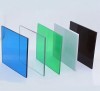
Clear and translucent polycarbonate panels can also allow natural daylight into the covered area.
How Should Buyers Select Polycarbonate Panels?
Small Door and Window Awnings
For small retail stores and standardized DIY awning products, solid polycarbonate sheets can be considered.
Typical configurations include:
- 2mm–5mm solid polycarbonate sheets
- Engineering plastic brackets
- Aluminum brackets
- Modular installation accessories
These systems are suitable for distributors serving different door and window sizes.
Medium Commercial Entrances
Restaurants, hotels, and larger storefronts may use hollow polycarbonate sheets according to the support structure.
Typical specifications include:
- 4mm–10mm hollow polycarbonate sheets
- Widths up to approximately 2.1m
- Customized lengths according to project requirements
Appropriate panel dimensions can help reduce unnecessary joints in longer awnings.
Why Does Structural Design Still Matter?
A transparent polycarbonate awning should not be evaluated by the panel alone. In regions with frequent heavy rainfall, the complete system is important.
Roof Slope
A suitable slope helps direct rainwater toward the drainage side and reduces water accumulation.
Bracket Spacing
Support spacing should be determined according to panel thickness, awning dimensions, and project design conditions.
Wall Connection
Door and window awnings are commonly fixed directly to exterior walls. Wall construction and fixing hardware therefore need to be considered during installation planning.
Panel Sealing
Aluminum profiles, rubber seals, and fixing hardware should be compatible with the selected polycarbonate sheet.
Key Parameters for B2B Buyers
For Southeast Asian retail projects, buyers can use a basic technical specification checklist:
| Item |
Typical Consideration |
| Panel Type |
Solid / Hollow Polycarbonate |
| Solid Sheet Thickness |
0.7mm–15mm |
| Hollow Sheet Thickness |
4mm–20mm |
| Common Maximum Width |
1.22m 2.1m |
| Length |
Customized according to project |
| Brackets |
Aluminum / Engineering Plastic |
| Application |
Door, Window, Storefront Awning |
| Installation |
Wall-mounted / Modular |
This specification approach allows distributors to develop clearer product ranges and helps end users select products according to their actual door and window dimensions.
Selection Trends in Southeast Asian Retail Projects
As convenience stores, restaurants, community retail spaces, and small commercial developments continue to expand, door and window awnings are increasingly becoming standardized building products rather than purely custom structures.
For importers and building material distributors, three factors are particularly relevant: natural daylighting, modular installation, and standardized specifications.
Polycarbonate awnings combine rain protection, daylighting, and lightweight construction, making them a practical material option for a wide range of Southeast Asian retail building applications.

 Your message must be between 20-3,000 characters!